Roots of polynomials are the values of x for which a polynomial evaluates to zero. For example, the roots of the polynomial x^2 - 5x + 6 are 2 and 3, since (2)^2 - 5(2) + 6 = 0 and (3)^2 - 5(3) + 6 = 0. The roots of a polynomial can be found using various methods, such as factoring, the quadratic formula, or numerical methods for higher degree polynomials. Understanding the roots of polynomials is important in many areas of engineering and science, as they can represent critical points, frequencies, or other significant values in a system.
The number of roots of a polynomial is equal to its degree, counting multiplicity. For example, the polynomial (x - 1)^2 has a degree of 2 and has one root, which is 1, but it is counted twice due to its multiplicity. The roots can be real or complex numbers, depending on the coefficients of the polynomial. The Fundamental Theorem of Algebra states that every non-constant single-variable polynomial with complex coefficients has at least one complex root. This means that polynomials can be factored into linear factors over the complex numbers.
In engineering, the roots of polynomials are often used to analyze the stability of systems, design filters, and solve differential equations. For example, in control systems, the roots of the characteristic polynomial of the system's transfer function can indicate whether the system is stable or unstable. In signal processing, the roots of the filter's transfer function can determine the filter's frequency response. Therefore, understanding the roots of polynomials is essential for engineers to design and analyze systems effectively.
Problem 1: Find the roots of the first-degree polynomial f(x)=x-3=0.
Since f(x) is a first-degree polynomial, it has one root. Setting f(x) to zero gives us x - 3 = 0, which means x = 3. Therefore, the root of the polynomial f(x) is 3.
Problem 2: Find the roots of the second-degree polynomial f(x)=x^2-5x+6=0.
To find the roots of the second-degree polynomial f(x), we can factor it or apply the quadratic formula.
Factoring: We look for two numbers that multiply to 6 and add to -5. The 6 is represented by the constant in f(x) and the -5 is represented by the coefficient of x. The two numbers are -2 and -3, since (-2) * (-3) = 6 and (-2) + (-3) = -5. Therefore, the polynomial can be factored as (x - 2)(x - 3) = 0. Setting each factor to zero gives us x = 2 and x = 3. Thus, the roots of the polynomial f(x) are 2 and 3.
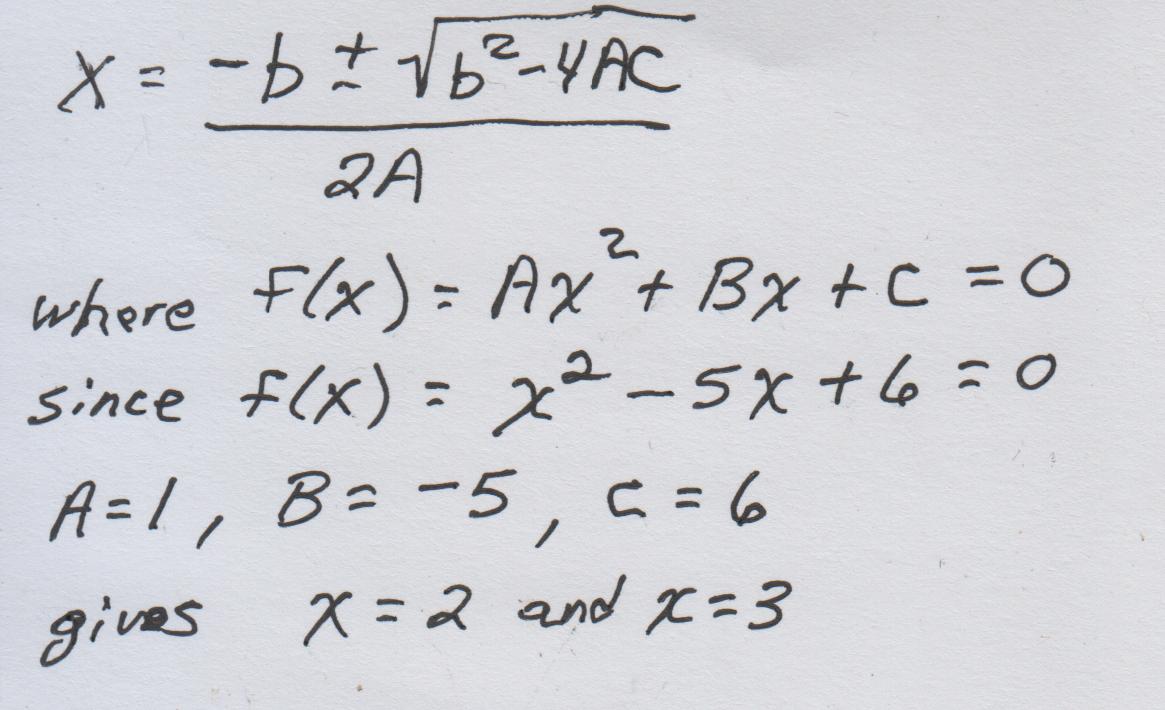
Quadriatic Formula: The quadratic formula states that for a second-degree polynomial ax^2 + bx + c = 0, the roots can be found using the formula x = (-b ± √(b^2 - 4ac)) / (2a). In our case, a = 1, b = -5, and c = 6. Plugging these values into the formula gives us x = (5 ± √((-5)^2 - 4(1)(6))) / (2(1)) = (5 ± √(25 - 24)) / 2 = (5 ± √1) / 2. This simplifies to x = (5 ± 1) / 2, which results in two roots: x = (5 + 1) / 2 = 3 and x = (5 - 1) / 2 = 2. Therefore, the roots of the polynomial f(x) are again confirmed to be 2 and 3.
Finding roots of polynomials can be found by using software applications like MATLAB. An open source program named SageMath can also be used for this purpose.
using SageMath:
sage: y=x^2-5*x+6==0
sage: y.roots(ring=QQbar)
[(2, 1), (3, 1)]
Which returns the roots of the polynomial and their multiplicities.
roots are 2 and 3 with multiplicity of 1 each.
Using MatLab:
>> coeffs = [1,-5, 6];
>> roots(coeffs)
ans =
3
2
Which also returns the roots of the polynomial.
Problem 3: Find the roots of the third-degree polynomial f(x)=x^3-6x^2+11x-6=0.
To find the roots of the third-degree polynomial f(x), we can attempt to factor it or use numerical methods. Let's try factoring first.
Factoring: We look for a factor of the form (x - r) where r is a root. By trial and error or using the Rational Root Theorem, we can test potential rational roots. Testing x = 1, we get f(1) = 1 - 6 + 11 - 6 = 0, so (x - 1) is a factor. We can then perform polynomial division to find the remaining quadratic factor.
After factoring out (x - 1), we are left with x^2 - 5x + 6, which we already know from Problem 2 has roots at x = 2 and x = 3. Therefore, the roots of the polynomial f(x) are x = 1, x = 2, and x = 3.